Financing delivery models
The roles local authorities can play in project development and delivery
ALPHA
Overview
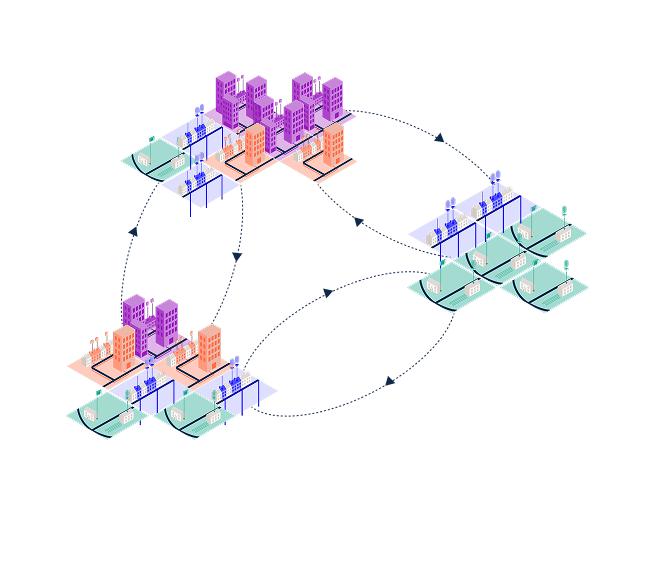
After identifying opportunity areas a local authority can take different approaches to support the delivery of clean heat projects in their area. We have identified a spectrum of delivery models for clean heat, primarily differentiated by the extent to which the local authority is directly involved in delivery and management of projects. Each distributes risk, governance and return differently. The right model for a particular aspect of the clean heat transition in your area depends on your local authorities’ asset base, delivery capacity, risk appetite and long-term goals. We envision that most local authorities will utilise a range of different models to deliver different types of projects.
The different types of projects
The section below illustrates a few examples of the different types of delivery approaches.
Market-led projects
In these projects, a private company independently takes the lead on developing and delivering a clean heat project. The market-led approach to heating is broadly how the current heating market works (for example for gas boiler and air source heat pumps), with customers and private companies directly engaging with each other to install, change and maintain heating systems. After developing a local heat plan a local authority would then take a largely hands off approach and let private companies use the plan as guide to which projects they may want to take forward, though it offers no guarantees that any individual projects will take place. A local authority may choose to engage in some activities to increase private sector interest in the delivery of clean heat. This may be through convening events to connect clean heat stakeholders, such as housing associations, and clean heat delivery partners.
Where we currently see the model developing/being used:
Individual heating solutions for privately owned homes
Communal solutions for privately developed new build homes
As the current dominant model in domestic heating systems this model may be best suited for individual technology solutions, such as heat pumps in owner-occupied homes. Consumers who have the means to pay for their heating systems upfront are already familiar with this system and it presents an efficient option for decarbonising individual properties.
When delivering area-based projects, especially those across multiple tenures or involving shared infrastructure, purely private delivery becomes more complex. A local authority will often have significant control over various assets involved in such a project, including local roads that may need to be dug up for pipework or social housing that may be needed as an anchor load. This means that any local authority will need to grant at least administrative approval to private developers. This administrative and ownership challenges means a market-led approach for shared infrastructure can often be most suitable for new build development where land is already privately owned, rather than retrofit scenarios.
What are the advantages and challenges?
Advantages
Limits financial risk for a local authority
Local authority does not need to allocate resources to project management or procurement
Challenges
Limited oversight on development and management of a project
Approach is not likely to deliver solutions in all opportunity areas
An advantage of any market-led project is that the financial risks associated with the development and maintenance of assets fall entirely with the company leading and scaling the project. This means a local authority is exposed to a minimal amount of financial risk. However it also means there are few opportunities to directly benefit from any of the potential financial upsides. Additionally, a local authority does not need to allocate capacity or resources to managing delivery, however this can also mean the local authority has less control over the management of the scheme, for example the cost of bills to consumers of heat from a heat network.
The challenges of area-based projects also mean that the market may not deliver a solution for all opportunity areas. For example, the private sector may not organically choose to propose complex retrofit projects using shared infrastructure that bring greater commercial risks to the developer and may not guarantee a good return on investment. The market-led approach is therefore unlikely to deliver all the clean projects in an area.
Case Study
Currently in the planning stage, the Melbourn Energy Superloop project in
Melbourn, Cambridgeshire, is managed by a consortium of companies including
DataGlow. It is a combined heat-and-power project that includes the generation
of energy to power a data centre owned by DataGlow. Waste heat from the
centre will be collected via an ambient ground loop and distributed to
households through ground source heat pumps.
Technologies: Solar panels, data centre, ambient ground loop and ground source
heat pumps.
Ownership model: The data centre and ambient ground loops will be owned by
DataGlow.
Funding Private: Capital (from Octopus Energy Generation) and public funding
(customers will need to apply for the BUS)
Market shaping projects
In this model a local authority takes a role in encouraging and shaping the way the private sector delivers clean heat. A clear way to do this may be by taking an active role in procuring projects to help deliver clean heat in the opportunity areas identified in its local clean heat plan, rather than leaving it to the private sector to identify and deliver projects. Local authorities have several options for their procurement model. For instance, an authority could outline a selection of specific schemes and individually put each one out to tender, commissioning a private company to complete the technical designs, deliver the project and manage the assets in the long term.
Alternatively, a local authority could establish a framework, allowing pre-qualified suppliers to compete for clean heat projects as they arise, be it from the local authority itself or from third sector and community organisations including housing associations or social landlords. Another route would be for an authority to enter into a concessionary agreement, granting a private company exclusive rights to design and deliver clean heat and/or other decarbonisation projects across the local area.
The specific financial structure of any clean heat scheme will likely be tailored to the individual project, negotiated between the commissioning local authority and the chosen delivery organization. This negotiation will determine the necessary blend of public and private funding for asset delivery, as well as the long-term ownership and management framework. Regardless of the specific procurement approach, these projects can be important to kickstart local clean heat delivery, stimulating the growth of a local supply chain, which in turn makes it simpler and more appealing for private building owners to also decarbonise.
Where we currently see the model developing/being used:
Delivering individual heating solutions for social housing
Developing heat networks and communal solutions with a strong business case
As the current dominant model in domestic heating systems this model may be best suited for individual technology solutions, such as heat pumps in owner-occupied homes. Consumers who have the means to pay for their heating systems upfront are already familiar with this system and it presents an efficient option for decarbonising individual properties.
What are the advantages and challenges?
Advantages
More control over which schemes go ahead
Control over determining performance indicators and setting for a project
Clearer coherence in local plans, able to schedule schemes over time.
Challenges
Procurement processes require resource for contract and project management
Procurement-focused models give public authorities greater control over project selection and long-term strategic alignment, ensuring clean heat schemes are coherently integrated into local plans and scheduled efficiently. However, this level of oversight requires significant internal capacity, as navigating complex procurement cycles and overseeing long-term contracts demands substantial resources and specialised project management expertise.
Public-private projects
In this model, a public body and a private company come together to deliver clean heat at an individual project scale (such as a social housing development) or at strategic scale for a city or local area. As opposed to just facilitating the market, in this model the local authority is an actor in managing projects in partnership with the private sector.
This model can lend itself to different legal arrangements, each with advantages and challenges though a joint venture (JV) or co-owned special purpose vehicle (SPV), amongst the most common. These are legal entities with ownership split between the local authority and a private company. The division of ownership can vary. For example, a JV may be a 50/50 split between the private and public sector. In a golden share arrangement a local authority may take a very small share in the SPV, a private company may deliver and operate the scheme but a public body will retain privileged control over the governance of the project, for example, to protect consumer prices or ensure protections and benefits for the local community.
Where we currently see the model developing/being used:
Delivering high capital, long-term projects that cover multiple tenures
Delivering most city-scale heat networks
Public-private partnerships such as JVs and SPVs are essential for high-capital, long-term clean heat projects. By combining public-sector land rights and anchor demand with private-sector technical expertise and capital, these structures bridge the commercialisation gap for complex infrastructure. While JVs provide a framework for long-term strategic collaboration, SPVs ring-fence financial risk, making large-scale decarbonisation projects more bankable and attractive to private investors.
What are the advantages and challenges?
Advantages
Offsets some of the risks associated with high capital projects
Can use private sector capacity and expertise in place of local heat bodies
The local authority retains control over its assets and sets the terms and objectives to the project
Greater potential for returns to the local community
Challenges
Procurement processes require resource for contract and project management
This model allows a local authority to minimise financial risk by bringing in private investment through a partnership. A private company will shoulder some (or perhaps most) of the main commercial risks associated with the project while still giving a public body strategic oversight of the scheme’s goals, albeit with fewer opportunities for scrutiny than in a public-led project. The procurement process may, however, be resource intensive and bring complexity to the project. A stakeholder also noted that, while scaleable, this model might also be more accessible to a local authority or region with assets for development, and came with legal and governance costs
Case Study
Bristol City Leap is a partnership between Bristol City Council, Ameresco Ltd. and
Vattenfall UK Heat Ltd. to accelerate decarbonisation across the city.
Its activities include clean heat and energy generation.
Technologies: Heat network (managed by Vattenfall), heat pumps, wind and
solar electricity generation.
Ownership model: Special Purpose Vehicle that grants Ameresco a 20-year
contract to coordinate retrofit projects across the city, including subcontracting Vattenfall to manage all heat network operations.
Funding Private: Heat Networks Delivery Unit and private capital.
Public sector delivery projects
In this model, the delivery and ownership for a clean heat scheme lies with a public
body, such as a local authority, which scopes, leads and secures funding for a scheme. The public body can fund the initiative either by using its own reserves; accessing external funds through borrowing from institutions such as the Public Works
Loan Board or national infrastructure banks; or accessing public grants. The project will be delivered and managed entirely by the local authority. A local authority may choose to create a separate special purpose vehicle to oversee the project and carry out long-term management. Many tasks during this will likely be procured out to external contractors - for example a civil engineering company will likely be contracted to construct pipework for a heat network - however the finished asset will be owned by the local authority. In this model, the public body which leads the project is responsible for developing a sustainable business model for the project.
A successful business model can secure a long-term income for a local authority and create long-term, publicly-owned assets that can generate other co-benefits in the local area. The model for a specific project is likely to be technology dependent, for example heat networks and shared ground loops will typically generate returns through heating bills while a collective heat pump installation scheme may generate service charges paid by consumers.
Where we currently see the model developing/being used:
Delivering shared infrastructure schemes which involve a high number of publicly-owned buildings (such as hospitals, social housing).
Delivering clean heat as part of existing public sector development projects, such as a local authority-led regeneration programme.
This model can be more suitable for shared infrastructure solutions, such as heat networks, which leverage existing public sector assets (such as social housing or a hospital) to guarantee demand. A publicly delivered project can be funded as part of a wider regeneration programme. For instance, a public sector-led regeneration project may involve selling connections to home developers on the site, thereby funding the heat network within the overall programme. Publicly owned schemes can also be a better regulatory option for communal solution technologies which have aspects of a natural monopoly, and public ownership can offer protections for consumers beyond existing consumer protection regulations.
What are the advantages and challenges?
Advantages
Maximum local control and coordination with other clean heat developments
Local authority develops a potentially profitable asset
Challenges
Exposes a local authority to maximum financial risk
Harder for the public sector to access the levels of capital required
Long-term responsibility and resource allocation for management
This model may be suited to local authorities with substantial internal delivery capacity and a willingness to take on the financial and operational risks associated with delivering a clean heat project. Those possessing significant social housing portfolios or other high-value assets can utilise these as collateral to secure the necessary funds.
Local authorities need to be invested in the management and maintenance of assets and customers over the long term, including being prepared to allocate resources to these activities and to generate a return from the assets. However, public ownership of assets also presents risks, as the local authority owning the asset will be responsible for repaying any debts accrued to finance the project. This means that a local authority leaves itself open to financial pressure if the project underperforms financially.
Case Study
Cardiff Heat Network uses waste heat from an energy-recovery centre, and was
recently connected to a newly converted block of 78 flats.
Technologies: Fourth-generation heat network using energy from waste (Viridor Energy Recovery Centre) as a heat source
Ownership model: Managed by Cardiff Heat Network Ltd., a subsidiary company
owned by Cardiff City Council
Funding Private: Heat Network Investment Programme and a loan from the Welsh
Government
Sign up to hear more
We are a building a network of areas, suppliers and community groups interested and working across low-carbon heat.
Sign up here if you would like to be notified about updates and opportunities to collaborate.