Communicating with households
Understanding the purpose of household communication and how to deliver it
ALPHA
Overview
This section of the playbook aims to provide guidance on how to communicate clean heat neighbourhood schemes to households, ensuring communication lands well with the community while embracing that people will have varying preferences.
Clean heat neighbourhood schemes can involve different technologies, delivery models and tenure arrangements. Without clear explanation, schemes may feel complex or difficult to navigate. Communication needs to make three things clear:
why change is happening locally
what applies to different homes and tenures
what the engagement pathways or actions are
One practical way to organise this communication is through a household-facing local clean heat plan.
A clean heat plan is a public service and source of information designed to communicate with households about the future changes to home heating. It builds early awareness, helps households understand how options relate to their home and tenure and outlines practical actions and support pathways available to them.
To ensure broad accessibility, the household plan integrates digital and physical channels: an online service recommended to be hosted on the local authority’s website, supported by physical touchpoints such as letters, leaflets and access to local advice services.

The purpose of this approach is to ensure that information is easy for households to understand and engage with.
Examples of household-facing clean heat plan formats
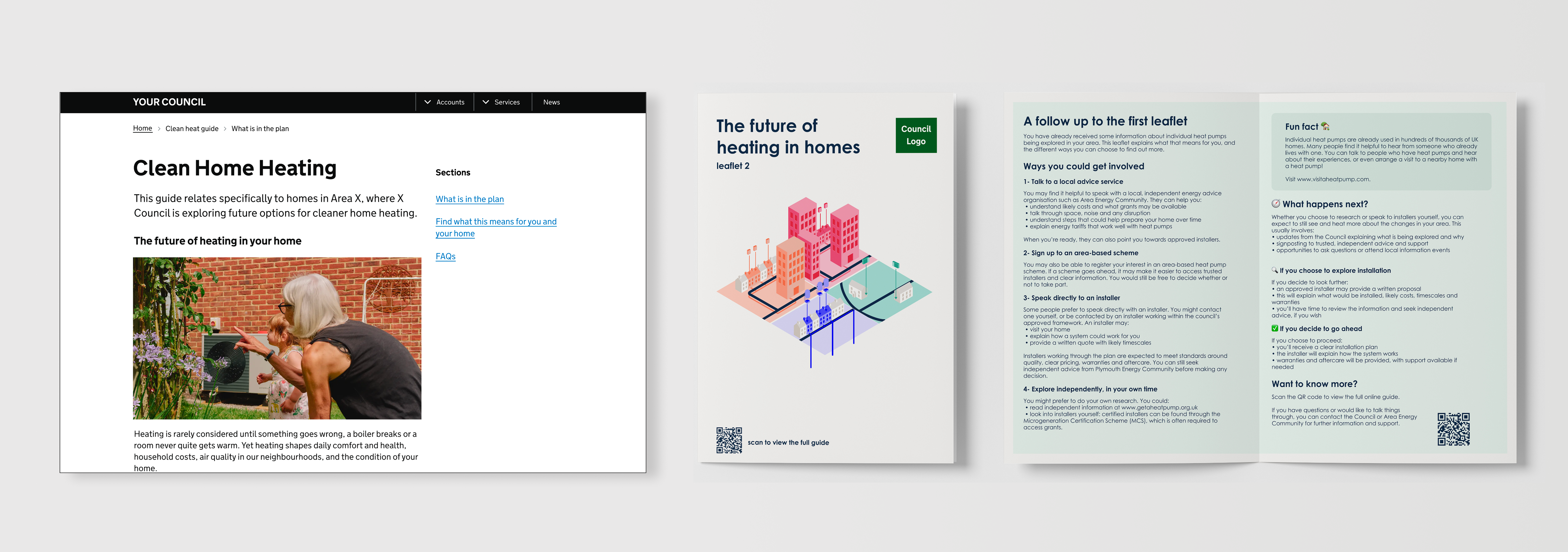
Illustrative prototypes showing how a household-facing clean heat plan could be presented across digital and printed formats.
The value for households
This section of the playbook describes the value the household plan should create for residents, based on workshop insights and wider engagement research. It sets out how the plan may influence residents’ understanding of the work, how it relates to their home and tenure and how they navigate next steps.

Testing a clean heat plan in Plymouth
An update on Nesta’s project using granular local heat planning to bridge the gap between strategic planning and delivery.

What do households want from clean heat neighbourhood schemes?
A blog from Nesta on what works for households to improve clarity, confidence and trust in heating choices.
1. Builds trust through council leadership
When information and guidance about what is being explored locally sits clearly with the local authority, it may feel more credible and trustworthy to residents. Rather than navigating fragmented or installer-led sources, households could feel more confident that the transition is being overseen responsibly at a local level, with a clear point of reference. This may help establish legitimacy from the outset and give residents greater confidence in the intent and oversight behind the work.
Residents consistently associated clean heating communication with the council and linked this directly to trust and legitimacy.
“I want to hear that councils are owning and driving that initiative.”
“When I have issues, I reach out to the council, there’s already trust.”
Participants contrasted council-led communication with fragmented or installer-led messaging, describing local authority oversight as more credible and reassuring.
2. Turning unfamiliar change into a managed transition
A local clean heat plan may help make an unfamiliar change easier to understand. By explaining what is being explored locally, how this relates to different homes and how information will be shared as work develops, the plan may support a clearer understanding of how change could unfold over time. This can help position heating change as something being approached deliberately and responsibly, rather than as a sudden or isolated shift.
Low-carbon heating was frequently described as unfamiliar and uncertain. One participant described the approach as making the move feel: “More like a transition.”
Residents responded positively when information was introduced in stages and when early explanations created space to understand why change was happening before being presented with specific technologies.
3. Making the change relevant to different homes and tenures
When differences in housing type and tenure are clearly reflected, residents can move more quickly from general context to information that relates directly to their home and role. Rather than navigating information that may or may not apply to them, households are able to see what the transition could mean in their specific circumstances. This supports a clearer, more relevant understanding of the change.
When shown wider plans or maps, attention quickly narrowed to individual homes and streets.
“What does this mean for my home?”
“Finding out your home or street is included” was described as the point people “really start paying attention.”
Tenure strongly shaped how residents understood their ability to act.
“Where do renters fit in?”
“Without the landlord’s permission, I won’t be able to do anything myself.”
Residents wanted clarity on how housing type and occupancy status affected responsibility and decision-making.
4. Making engagement clearer and easier
Clear information about the stages of the journey - where responsibilities sit and what actions are available to people in different tenures - may reduce how much work households feel they must do on their own to understand the topic and their role in the process.
For some households, this may include being able to move through a more visible end-to-end journey: understanding options; accessing advice; and exploring installation or joining an area-based scheme if they choose. For renters and social housing tenants, this may include staying informed, preparing questions, registering interest and using supported routes to engage. Making visible in the plan where people can go to ask questions, see real-world examples and speak with trusted local organisations may also mean residents do not have to navigate the process on their own.
Together, this can create easier and more structured ways for residents to engage.
Clean heating was often described as complex and time-consuming. One participant said that getting a heat pump would feel like “A part-time job”. This was contrasted with replacing a gas boiler - “Replacing a gas boiler is easy, it’s already set up.”
Residents valued clear stages, visible next steps and clarity on where responsibility sits. They expressed interest in having somewhere they could return to for information about milestones and progression, and in being signposted to trusted local organisations and real-world examples.
The value for local authorities
For councils considering how to engage and communicate with households as the work develops, the plan could add value in the following ways:
1. Enabling earlier, council-led explanation of the work
It may give the local authority a way to introduce and explain clean heating work at an earlier stage, while options are still being explored. This allows the council to set out context, intent and scope before any proposal is defined or activity becomes visible on the ground.
Early, council-led communication may help residents form an initial understanding of what is being explored and why. In turn, this could reduce confusion or defensive reactions if work progresses.
Residents responded positively when the council created space for early exploration and explanation.
“As a resident, I really appreciate the thoughtfulness from the council for running this workshop.”
“In this session you’re answering my questions and now I’m curious, I’m starting to imagine something radically different.”
2. Providing a structured reference point for ongoing communication
It may support councils by providing a clear and consistent reference point households can return to as questions arise. By bringing together tailored information in one place - such as how options relate to different homes and tenures - it may reduce the need to repeatedly explain core information across individual enquiries.
By signposting households to trusted advice services, independent information and real-world examples, the plan may also help avoid positioning the council as the sole source of detailed explanation, while still ensuring residents can access reliable and consistent information over time.
Sign up to hear more
We are a building a network of areas, suppliers and community groups interested and working across low-carbon heat.
Sign up here if you would like to be notified about updates and opportunities to collaborate.