Household plan: leaflet two guide
Recommendations on how to communicate next steps in leaflet two sent to households
ALPHA
Leaflet two: Present actionable next steps
Aim: to explain what the identified clean heating option means for the household and what engagement or action could look like in their specific circumstances.
The purpose of this leaflet is to ensure that households can clearly answer two further questions:
What is my role in this process?
What can I do next if I choose to engage?

This leaflet is personalised by tenure. The information shown reflects whether the household owns their home, rents privately or lives in social housing. This ensures the guidance reflects the household’s role, responsibilities and available routes for engagement.
What the leaflet should communicate
1
Why they are receiving this and what it means for them
The leaflet should explain that it follows the previous communication about the clean heating option being explored in the area. Its purpose is to clarify what this means for the household and what engagement could look like in their situation.
It should make clear that different households have different roles in the process. Decision-making and coordination may sit with the homeowner, landlord, housing provider, or a delivery partner depending on the tenure type. The leaflet should therefore clearly explain where responsibility sits before presenting possible next steps.
2
What their role is in the process
The leaflet should explain how the household’s tenure shapes their role in the transition.
For owner-occupiers, this may include exploring installation independently; speaking to installers; joining an area-based scheme; or seeking advice to understand whether a heat pump could suit them.
For private renters and social housing tenants, the leaflet should clarify that decisions about heating upgrades usually sit with landlords or housing providers. However, residents can still play a role by staying informed, asking questions, registering interest, or sharing information through tenant-information packs with their landlord or housing provider if relevant.
The aim is to help residents understand what is within their control and what is not, so engagement feels clearer and less uncertain.
3
Ways households could engage
The leaflet should present clear and practical ways households can get involved if they wish. These engagement routes should reflect the resident’s position and level of control, rather than listing every possible pathway.
Examples may include:
- speaking to a local independent advice service
- registering interest in an area-based scheme
- contacting approved installers
- discussing options with a landlord or housing provider
- exploring the option independently through trusted sources
Where relevant, the leaflet should reassure residents that engaging at this stage does not commit them to any action.
4
What could happen next
The leaflet should provide a simple explanation of how the process could unfold if plans progress. This should describe the journey in stages, for example:
- early updates and information from the council
- clearer proposals or feasibility studies
- confirmation of plans and timelines
- installation and aftercare (if a scheme goes ahead)
Within this explanation, the leaflet should clarify who residents might expect to hear from at each stage, such as the council, housing providers, installers, or scheme operators.
Providing this visibility helps residents understand the sequence of events and reduces uncertainty about timing.
5
Call to action
The leaflet should provide clear routes for residents who want to find out more or seek support. This may include:
- signposting to the full online clean heat guide
- providing contact details for local advice services
- directing residents to trusted independent information sources
- inviting residents to register interest or ask questions
The call to action should make clear that engaging is optional and that support remains available over time.
Example prototypes
Below are two illustrative examples showing how leaflet two could be presented. Each prototype reflects the same structure and communication principles described above, adapted to a specific tenure and technology:
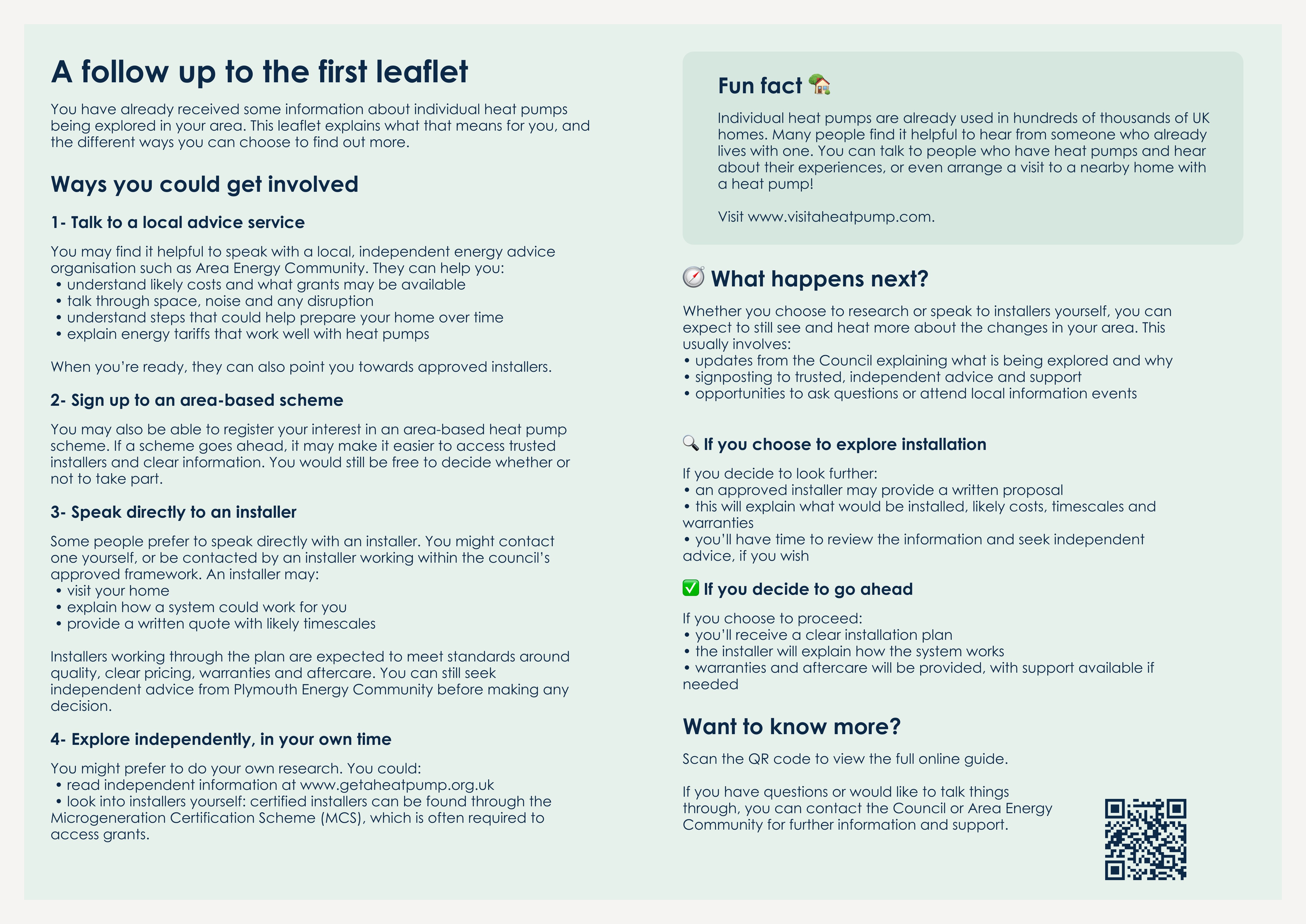
1. Owner occupier + individual heat sources
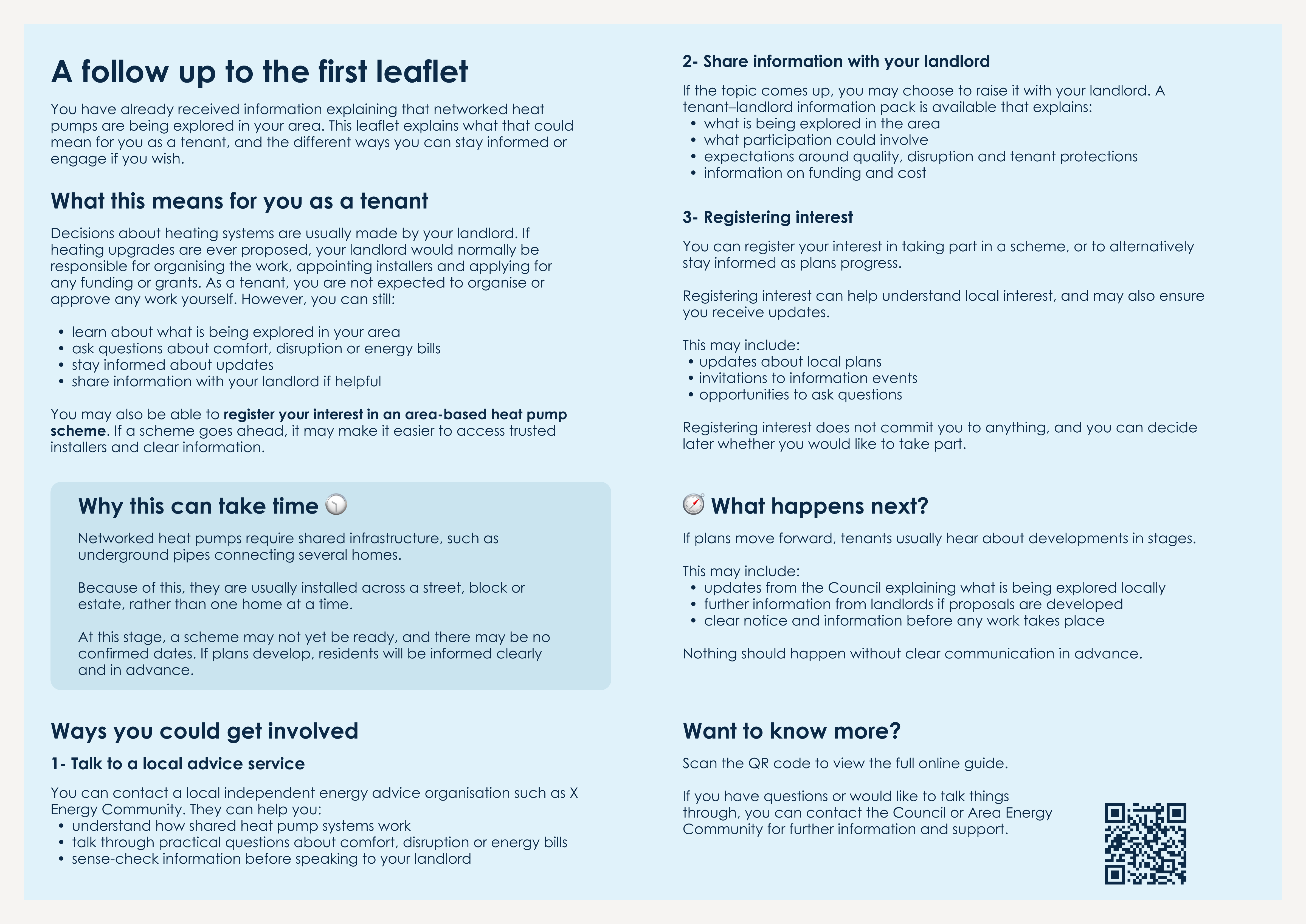
2. Private renter + networked heat pumps
Leaflet example: owner occupier + individual heat source
Illustrative prototype of a leaflet for owner occupiers where individual heat pumps are being explored.
Example
Leaflet example: private renter + networked heat pump
Illustrative prototype of a leaflet for private renters where networked heat pumps are being explored.
Example
Sign up to hear more
We are a building a network of areas, suppliers and community groups interested and working across low-carbon heat.
Sign up here if you would like to be notified about updates and opportunities to collaborate.